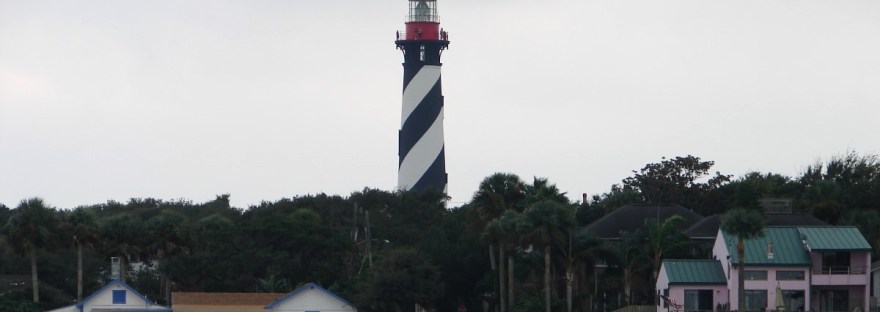
St Augustine, Florida
In 1824, a new brick tower, rising to a height of seventy-three feet, was placed in service in St. Augustine, the leading port in the newly acquired Territory of Florida. The establishment of this lighthouse marked the U.S. Government’s swift response to the need for a guiding light to mark the inlet. However, the light was extinguished shortly after the outbreak of the Civil War, and the tower remained dark until after the conflict ended. It was during this period that erosion began to pose a significant threat to the tower’s stability, highlighting the urgent need for remedial action.
Recognizing the imminent danger, it was determined that a new lighthouse was required to ensure the safety of maritime traffic in the area. Consequently, a five-acre tract, located a half-mile inland, was acquired for the construction of the new lighthouse. This strategic move aimed to address the challenges posed by erosion and secure a safer location for guiding maritime vessels. The acquisition of the land marked the beginning of a new chapter in the history of lighthouses in the region, as efforts were directed towards the establishment of a sturdier and more resilient structure to serve the coastal community.

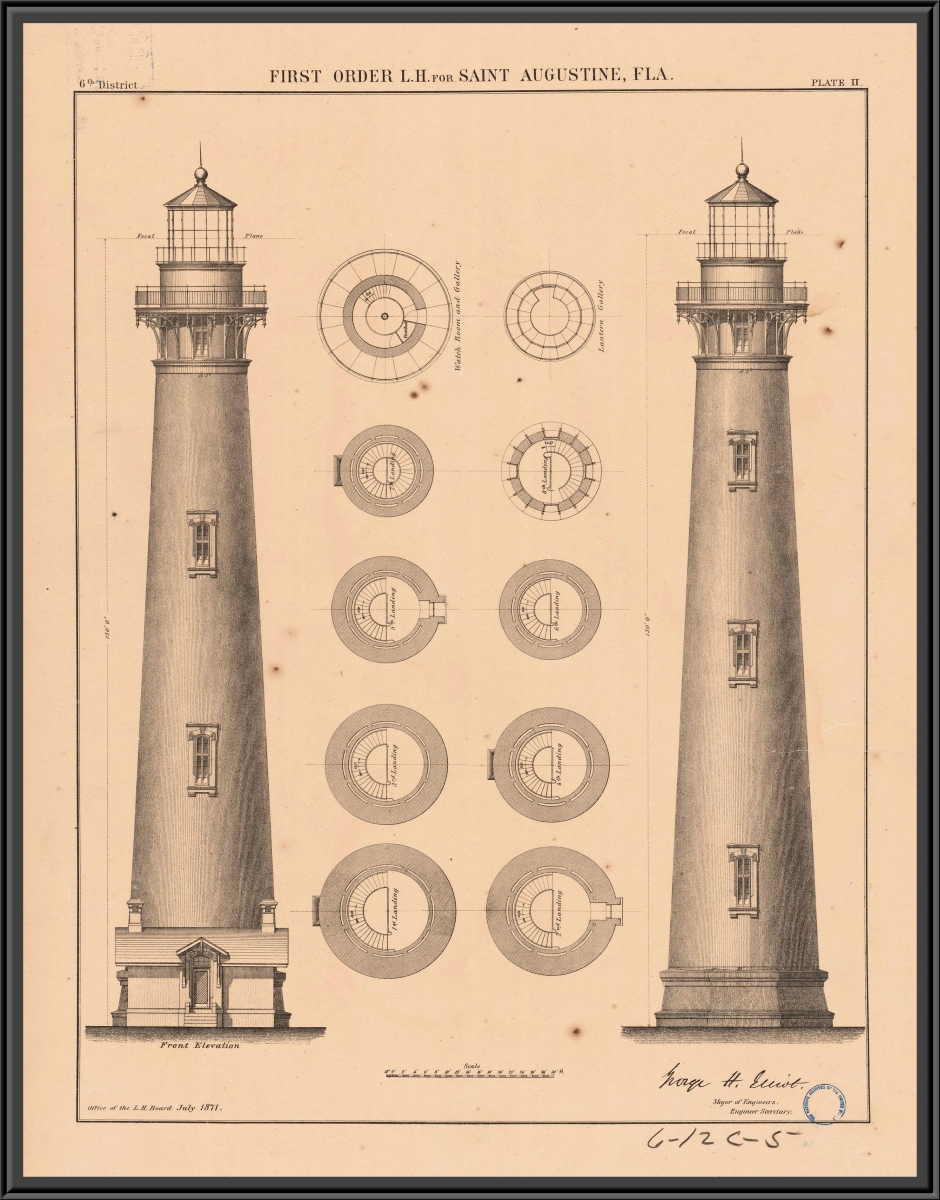
Postcard of 1824 St Augustine Lighthouse / Plans for 1874 St Augustine Lighthouse
Plans for the new lighthouse were drawn up by Paul Pelz, Chief Draftsman of the Lighthouse Board and who would later be one of two architects responsible for designing the Library of Congress. Construction on the lighthouse began in 1871, but the walls had grown to a height of just a few feet when funds were exhausted. Work resumed after additional funding was obtained, and the lighthouse commenced operation on October 15, 1874. The tower was built using brick from Alabama, granite from Georgia, iron work forged in Philadelphia, and a first-order Fresnel lens crafted in France.
Constructing the new lighthouse proved to be a prudent move as the old tower toppled into the sea on August 22, 1880.
For the Disabled Traveler with limited mobility and can climb stairs, there are 219 steps to reach the observation deck. There are also eight landings, one with a bench, where the Disabled Traveler can rest and let other people pass. For the Disabled Traveler who is confined to a wheelchair, the St Augustine light station is a historic site, and certain areas are accessible only by stairs including the Lighthouse Tower. Accessible parking is available with wheelchair ramp access to the Visitors’ Center. Once inside the Center, an orientation exhibit begins the lighthouse experience. An alternative short entrance path is available from the handicapped parking to the grounds, the staff will open the gate upon request. A ramp provides access to the ground floor of the Keepers’ House, containing exhibits. Stairs lead up to the second floor of the Keepers’ House.

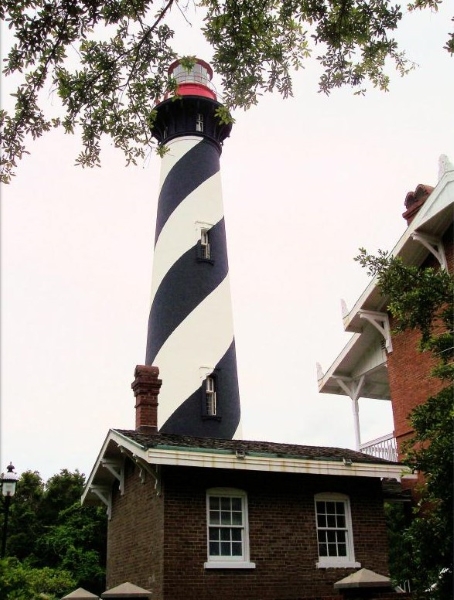
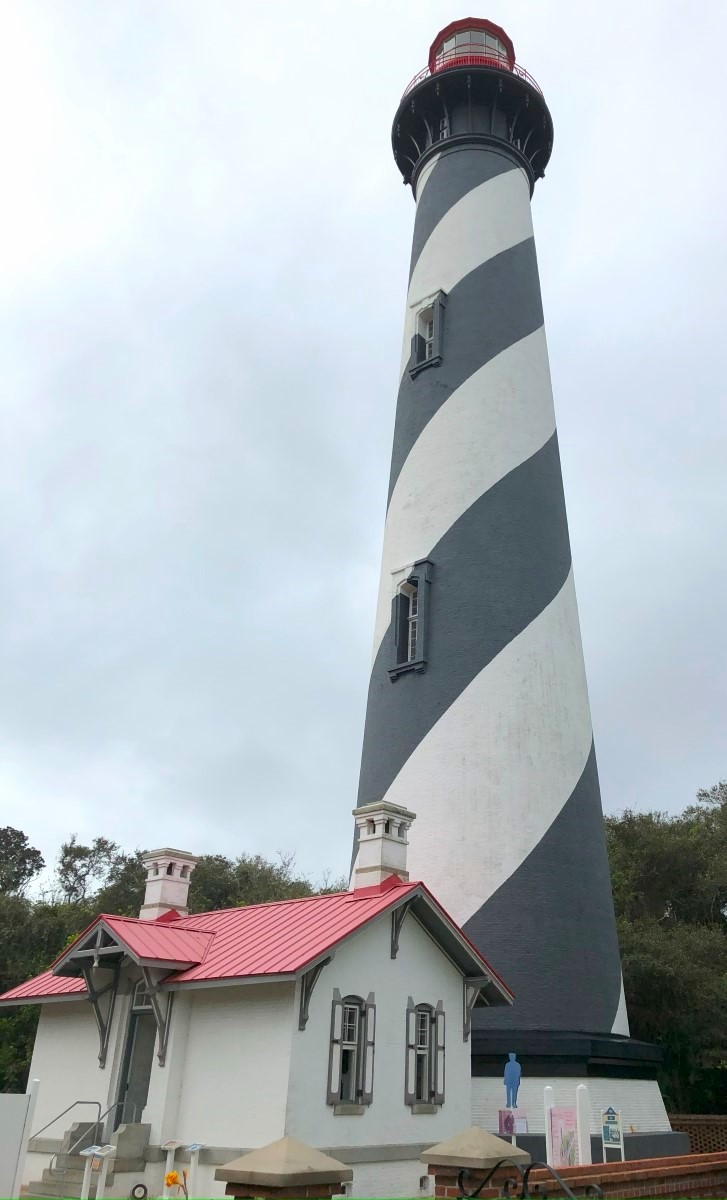
Other exhibits, including the Artifact Conservation Lab Viewing Hallway, in the Maritime Education Center, are wheelchair accessible. In case of temporary exhibits, complimentary materials are available for consultation by those who cannot climb the stairs. The video “View from the Top” video is available to those unable to climb the tower in the ADA-accessible Maritime Education Center, which houses exhibits where guests can learn about the St. Augustine Lighthouse, see a ship model display, a puppet theater and hands-on activities for children. All public restrooms are wheelchair accessible and a large-print, self-guided walking tour is available in the Visitor’s Center.

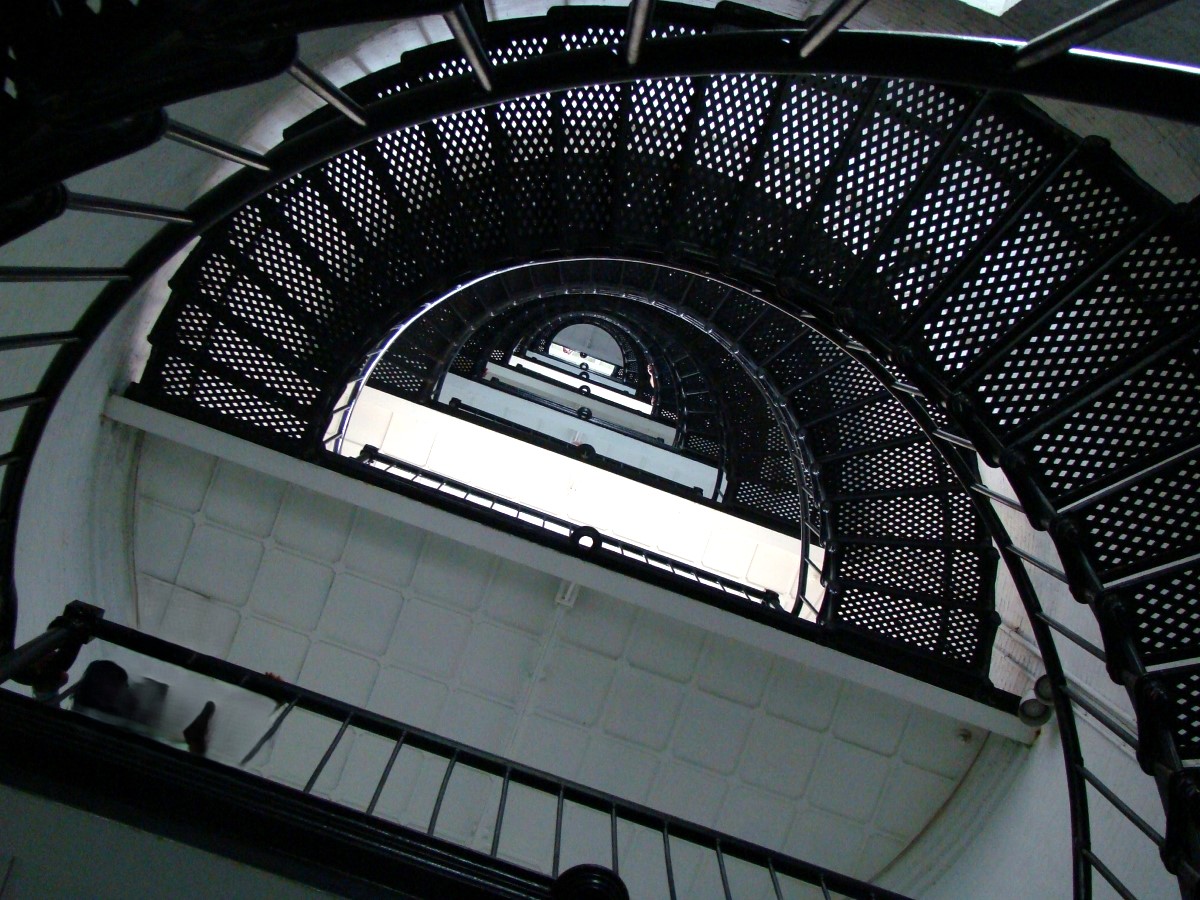
Keeper’s House / Looking up in St Augustine Lighthouse
Historical Information
- Station Established: 1821
- Year Current Tower(s) First Lit: 1874
- Operational? YES
- Automated? YES 1955
- Foundation Materials: Coquina, Stone, and Brick
- Construction Materials: Brick, Coquina, Stone & Iron
- Tower Height: 52 feet (1st); 165 feet (2nd)
- Tower Shape: Conical Brick Attached to Storage Bldg
- Number of Stairs: 219
- Markings/Pattern: Black/White Spiral Bands w/Red Lantern
- Original Lens: First Order Fresnel, 1874
- 1824: An old Spanish watchtower became the first lighthouse in Florida. Lamps from Winslow Lewis were used.
- 1855: A fourth order Fresnel lens replaced the old lamps.
- 1867: The first lighthouse was relit after the Civil War. During the war, Confederate supporters removed the Fresnel lens from the light and hid it.
- 1871: Construction of a new lighthouse was started.
- 1874, 14 October: The old lighthouse was lit for the last time.
- 1874, 15 October: The new lighthouse was lit for the first time. A first order Fresnel lens with a 3-minute fixed flash was used. Lard oil was used as the fuel to light the lighthouse.
- 1876: The keepers moved to the new station.
- 1880: The old lighthouse crashed into the sea.
- 1885: Kerosene replaced lard oil to light the lighthouse. A new oil house was built to store kerosene.
- 1907: Indoor plumbing was added to the site.
- 1925: Electric lights were installed in the keeper’s quarters.
- 1936: The light was electrified. The new characteristic became a 30 second flash.
- 1955: The lighthouse was automated, and the last keeper retired.
- 1960: The keeper’s house was declared surplus property and was put up for sale. The quarters were boarded up and left neglected.
- 1970: While negotiations were in progress, the house fell victim to arson. St. John’s County purchased the property for $29,000.
- 1981: The lighthouse was placed on the National Register of Historic Places.
- 1982: The Junior Service League signed a 99-year lease with the county for the keeper’s house and surrounding grounds, and a 30-year lease with the Coast Guard to begin a massive restoration effort.
- 2000, October: The new visitors center was opened.
- 2002: The lighthouse is an official, privately-owned, active aid to navigation. The St. Augustine Lighthouse & Museum, a not-for-profit organization, owns and maintains the light station.
A visit to the St. Augustine Lighthouse & Maritime Museum is more than you might expect! Even for the Disabled Traveler who is unable to climb to the top of the lighthouse, there is so much more to see. The grounds are beautiful, the displays are informative, a wonderful feat of maritime engineering makes this a wonderful place to visit. The Disabled Traveler will learn about American history, the local history of St. Augustine and about archaeological techniques used to excavate maritime sites. On the grounds there is a play area for kids, a snack bar to keep you refreshed and of course the gift shop. Overall, a fun and educational experience.

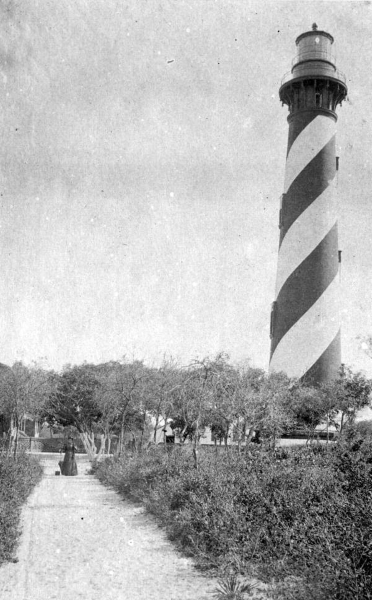
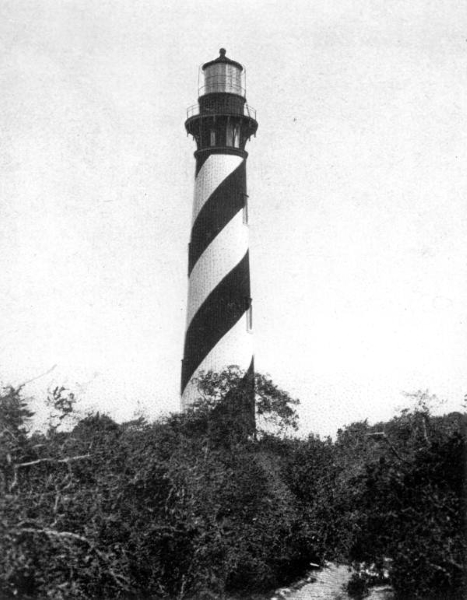
Historic Photos of St Augustine Lighthouse in 1891; 1893 and 1904 – USCG

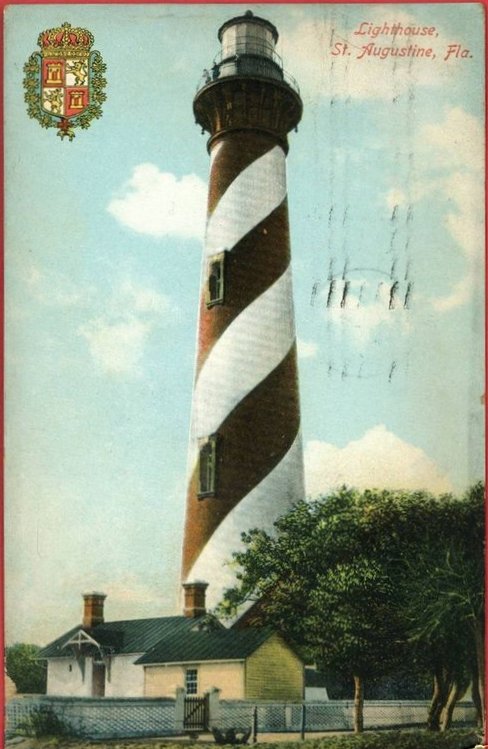
St Augustine Lighthouse ca 1936 USCG / Post Card St Augustine Lighthouse ca 1910
St Augustine Lighthouse & Maritime Museum

 The Disabled Traveler