
Jupiter, Florida
Since 1860, the Jupiter Inlet Lighthouse has been a crucial maritime and communication landmark, preventing numerous ships from wrecking on the reefs and shoals between the Florida coast and the stunning blue Gulf Stream.
Situated in Lighthouse Park, the Jupiter Inlet Lighthouse & Museum provides climbing tours of the historic 1860 lighthouse. The outdoor exhibits feature the Oil House & Keepers Workshop Exhibit, Tindall Pioneer Homestead, and Seminole Chickee. The Disabled Traveler can enjoy the gift shop, sunset and moonrise tours, along with other special events. Hiking trails and an observation tower are accessible on both the north and south sides of Beach Road. The Jupiter Inlet Lighthouse is on the National Register of Historic Places and is included in the 120-acre Jupiter Inlet Lighthouse Outstanding Natural Area, a federally designated land.
For the Disabled Traveler, free parking near the entrance is accessible. A wheelchair ramp accesses the Admissions & Gift Shop facility and grounds restrooms are accessible. Once your entrance fee is paid, you may access the grounds. A wide brick pathway winds around the Tindall Pioneer Homestead, Seminole Chickee and Native American Kiosks. A ramp equipped with handrails provides access to the Tindall Pioneer Homestead exhibit.

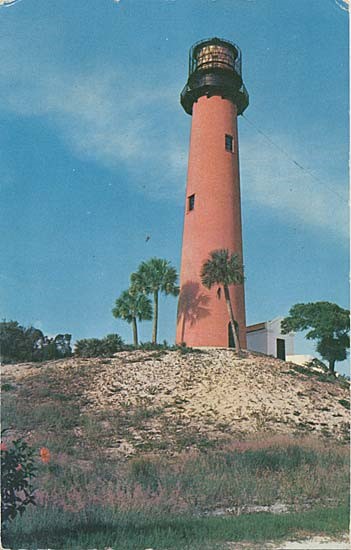
Jupiter Inlet Lighthouse – Historic Postcard of Jupiter Inlet Lighthouse from 1950s
Base tours of the Lighthouse tower are available, with the path from the admissions area to the Lighthouse deck spanning approximately one-quarter of a mile. For the Disabled Traveler who cannot climb, Lighthouse Tour guidebooks are obtainable at the admissions desk. These guidebooks are intended for use during the tour and should be returned upon its completion. Non-climbing visitors who wish to stay on the shaded deck can request materials that describe the climb and the views from the tower top at the registration desk. Additionally, the indoor Keepers Workshop exhibit offers interactive displays about the Lighthouse and its Keepers.
The deck of the Lighthouse is wheelchair-friendly, offering views of the Keeper’s Workshop, Banyan Tree, Cistern, and the Jupiter Inlet along with the Lighthouse grounds. However, as an historic site, the light station has areas that are only accessible via stairs, including the Lighthouse tower. For the Disabled Traveler with limited mobility, there are 34 steps up a hill from the deck to the base of the Lighthouse tower, followed by 105 steps to reach the top of the lighthouse.


Jupiter Inlet Lens – Jupiter Inlet Lighthouse
The grounds are beautifully maintained with several buildings open for exploration. The lighthouse itself is in excellent condition and offers a stunning view. Climbing it is relatively easy compared to other lighthouses. At the base, there’s a check-in point where visitors inform the staff at the top about the number of climbers. This ensures safe passage on the narrow spiral staircase. To reach the lighthouse, there are 34 steps, followed by another 105 steps to ascend to the top. Every 25 steps, there are platforms inside for rest. The panoramic view from the top is breathtaking. Climbing is highly recommended if possible. Even if climbing isn’t an option, the grounds are still wonderful for a leisurely stroll and discovery.
- Location: The northern bank of the Loxahatchee River in Jupiter Lighthouse Park in the city of Jupiter.
- Latitude: N 26.94861
- Longitude: W 80.08207
- Year Constructed: 1860 (George G. Meade) Active
- Tower Height: 108 feet Focal Plane: 146 feet
- Brick tower, painted brick red; lantern painted black. The original rotating 1st order Fresnel lens remains in use.
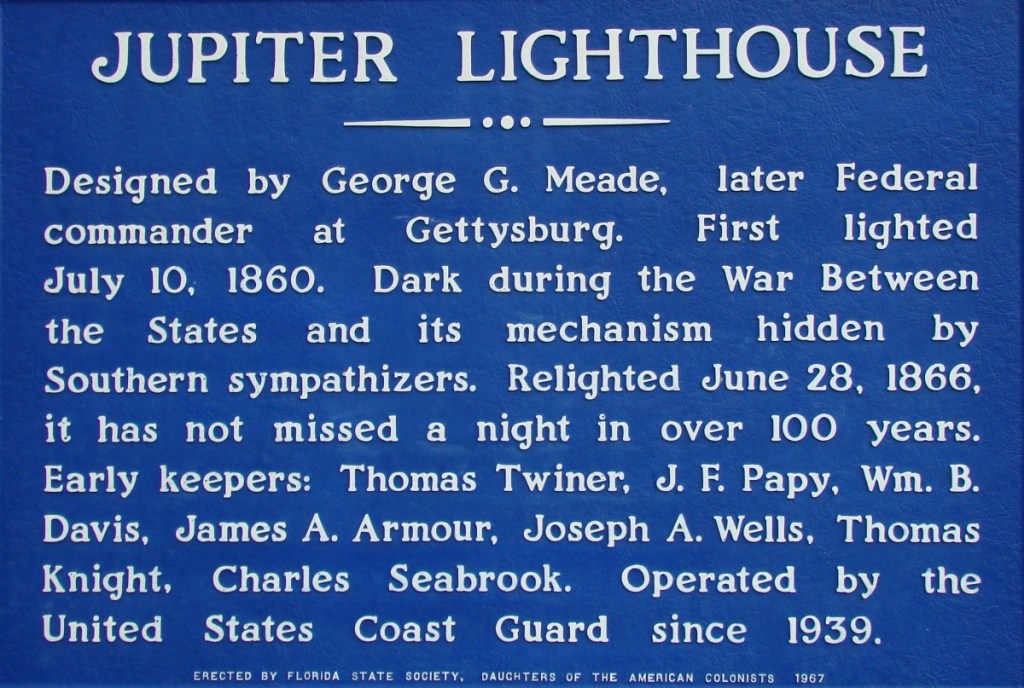
HISTORY: In 1853, Congress allocated funds for a lighthouse near Jupiter Inlet to mark the perilous shoals off that point and to navigate ships along the coast. The subsequent year, President Franklin Pierce signed an order reserving a 61.5-acre tract for the tower at the confluence of the Loxahatchee and Indian Rivers. Nevertheless, a survey in the 1920s revealed that the reservation encompassed 122 acres.

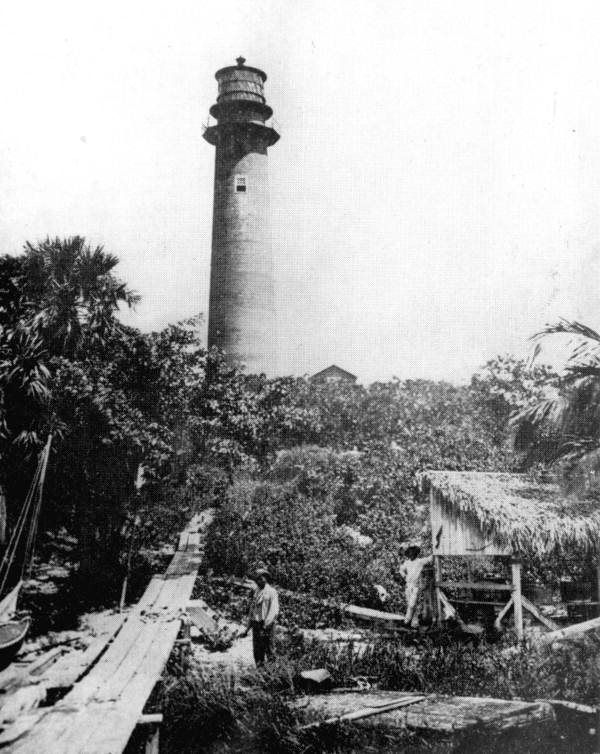
The lighthouse was one of six sites selected in the state following the recommendations of U.S. Army Corps of Engineer Surveyors. George Gordon Meade, a young Army Lieutenant born in Cadiz, Spain, was tasked with all six projects. He later became the General who defeated Robert E. Lee at the Battle of Gettysburg. It is believed that Lee was among the surveyors who identified the Jupiter Inlet site for a future lighthouse. While Meade drew the original design for the Jupiter Inlet Lighthouse, Lieutenant William Raynolds refined the final design, enhancing it with additional height, watch room portholes, and double wall construction. Captain Edward Yorke completed the construction of the tower in May 1860.
Construction of the tower commenced in 1855. However, work on the lighthouse was halted due to hostilities with the local Indian population. In 1858, once the conflict had been resolved, construction continued. Yet, the workers faced more than just resistance from the Indians; they also contended with environmental challenges. Following the lighthouse’s authorization, a storm sealed the inlet, leading to stagnant waters and the spread of malaria. Consequently, all building materials had to be transported via small barges down the Indian River from the closest inlet at Fort Pierce. Many workers contracted “Jupiter Fever,” likely a mix of malaria and yellow fever, while others endured the extreme heat and numerous biting insects.

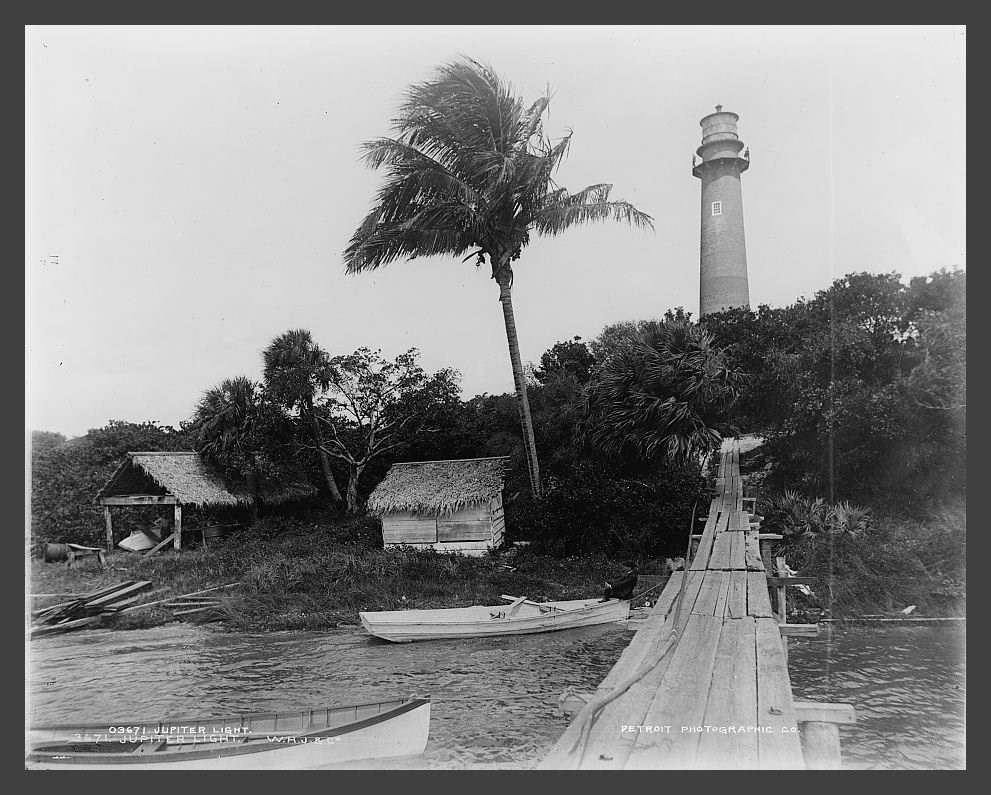


Jupiter Inlet Lighthouse Historical Photos–ca 1880-1910–FLSL (see photo title for description)
The Jupiter Inlet Lighthouse began operations on July 10, 1860, but the Civil War soon interrupted its functioning. By August 1861, the illuminating apparatus had been removed by a group of marauders, leaving the lighthouse unlit for the duration of the war. It wasn’t until June 28, 1866, that the lighthouse was relit. Since then, it has served as a continuous navigational aid, housing one of the only 13 active First-Order Fresnel lenses in the United States. James Armour, instrumental in helping the Union Navy reclaim parts and supplies removed from the lighthouse during the war, became one of the lighthouse’s keepers and was promoted to Head Keeper in 1869. His tenure lasted until 1906, marking an extraordinary 40 years of service.
- Station Established: 1860
- Year Current Tower(s) First Lit: 1860
- Operational: YES
- Automated: YES 1928
- Foundation Materials: OYSTER SHELLS
- Construction Materials: BRICK
- Tower Shape / Markings / Pattern: Tower of red brick, natural color; oil-house near tower. One-and-a-half story stone dwelling and two-story white dwelling.
- Height: 146-feet
- Original Lens: FIRST ORDER, FRESNEL 1860
- Characteristic: Fixed white varied by a white flash every 90 seconds
- Building was designed by George Meade. Construction was interrupted by the 3rd Seminole War (1855 – 1858).
- 1860 – Lighthouse first lit on July 10th.
- Civil War – Confederates sabotaged the lens and rotating apparatus so that the lighthouse became inoperative.
- 1866 – The light was relit on June 28.
- 1886 – Life-saving station established near the lighthouse.
- 1879 – Lighthouse survived two earthquakes.
- 1910 – Due to deterioration, the exterior brick was covered with red-colored cement.
- 1928 – Lighthouse was electrified. Then, in September, a powerful hurricane knocked out the electricity forcing the keeper’s son (subbing for his injured father) to turn the rotating mechanism by hand. The hurricane also caused the lighthouse to sway 17” and the wind blew glass out of the lantern & broke one of the bulls-eyes in the lens.
- 1959 – Keeper’s house torn down, and new quarters built.
- 1973 – Added to National Register of Historic Places.
Jupiter Inlet Life Saving Station
The Jupiter Inlet Life Saving Station, established in 1885, and remained operational until 1899. Located near the Jupiter Inlet Lighthouse in Jupiter, Florida, the station was a two-story edifice perched on a bluff one mile south of the Jupiter Inlet. It featured a four-sided lookout tower atop its roof, equipped with signal flags and a powerful spyglass on a tripod. The ground floor housed a cloakroom, a utility room, and a self-bailing lifeboat on a wagon, ready to launch via a wooden ramp leading to the beach. The second floor was dedicated to the crew’s living quarters, furnished with iron cots and lockers. Captain Charles Robert Carlin, who had served as an assistant keeper at the Jupiter Lighthouse, was the station’s keeper.


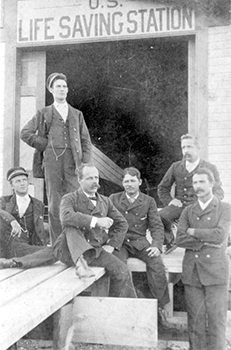
Jupiter Inlet US Life Saving Station–ca 1890–FLSL
After 1896, no Surfmen were employed. Captain Carlin continued to work, enlisting volunteers in times of emergency. The USLSS station at Jupiter Inlet was decommissioned on January 21, 1899. Captain Carlin passed away in 1912 due to injuries sustained while attempting to rescue the remaining life-saving station from a brush fire.
Regrettably, the original 1885 station house no longer stands, yet its legacy endures as a part of our national life-saving history.


Jupiter Inlet Lighthouse & Museum

 The Disabled Traveler